Hi~welcome to shenzhen xinmu display technology co., ltd.!

News Center

hotline:

13632760729

Where is the LED display parameter setting hidden?

2025-06-19 191

Do friends who are new to LED screens often get confused? The screen is clearly powered up, why does the color look like an old photo with faded color? Or do you always feel like you are stuck in PPT when playing videos? Ninety-nine percent of these problems that make novices crazy are the parameters that are not adjusted correctly. Today, we are like looking for a remote control battery compartment, turning the parameters to the bottom.

LED显示屏参数设置到底藏在哪?

1. Three hiding places for parameter settings

Do you think the parameters are posted on the screen? Too naive! This thing is like a mobile phone setting, hidden in three levels:

​Layer 1: Physical keys on hardware​
There are five mysterious buttons hidden in the lower right corner of some screens. Press the middle key for 5 seconds to enter the engineering mode. The basic brightness contrast can be adjusted here, but be careful not to touch the gamma value randomly - last time a buddy misaligned this parameter, and the entire screen was as gray as a smog day.

​The second layer: control system software
This is the highlight. Connect the receiving card through the computer and you will see the full screen of English abbreviation:

  • ​HDR​(not the one taking a photo): High dynamic range switch
  • ​PWM​(not a car repair term): Dimming frequency setting
  • ​Color Space​​: Color gamut mode switching
    The key point is here! The refresh rate must be ≥1920Hz, otherwise a black scanning line will appear when shooting the screen, which is the same as shooting the TV.

​Layer 3: Video source equipment
A blind spot that many people ignore. When connecting to the computer with an HDMI cable, if the graphics card output is set to 30Hz, it will be useless even if the screen supports 1920Hz. It's like using a tractor engine to carry a sports car, which can't perform at all.


2. Detailed explanation of five deadly parameters

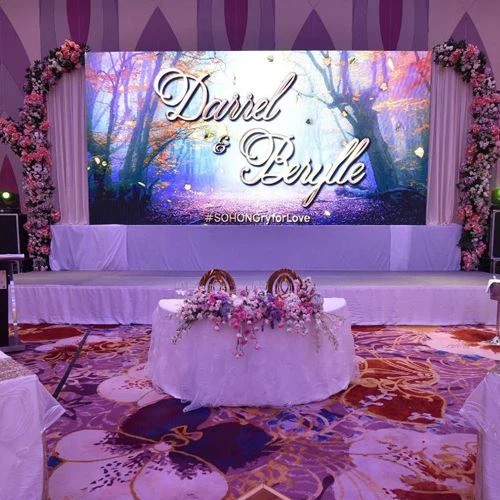
Last week, I helped my friend adjust the wedding stage screen and found that he set the grayscale level to 8 bits, and the color was broken like an oil canvas when playing the sunset video. These parameters must be fought hard:

​1. Brightness (Nits)
It is recommended to have an indoor screen of 800-1200, and it is recommended to have an outdoor screen of 4000. There is a simple test method: 3 meters in front of the screen at noon, you can see the details of the text clearly. It will be dazzling if it is too bright and too dark like a layer of yarn.

​2. Color temperature (K value)​
6500K is standard white light, and 3000K warm light is used for weddings. But be careful! The color temperature of the playback device must be synchronized with the screen, otherwise it is like wearing sunglasses to watch a color-shaved TV.

​3. Refresh rate (Hz)​
If the naked eye exceeds 1000Hz, it is hard to tell the difference between the camera shutter speed when shooting. There is a formula: refresh rate = camera frame rate × multiple + margin. For example, if you shoot 60 frames of video, the screen flash setting is 144Hz is the safest.

4. Grayscale
Don’t be fooled by the 16bit mentioned by the merchant. In fact, the effective grayscale depends on the card reception ability. Simple test: Play a gradient gray picture, and you can divide 16 color blocks into passing the exam, and 32 are excellent.

​5. Color consistency
Use a piece of white paper to compare the white screen. If it is blue or yellow, hurry up and enter the white balance calibration. Professional debugging requires a colorimeter, but it is also possible to download a color calibration app on your mobile phone during emergency situations.


3. The pit we strayed in those years

Last year, a shopping mall opened with a big screen and made a joke: it was well debugged during the day, but when advertising at night, people's faces were as green as aliens. Later I found out that it was not opened​Ambient light sensing​, the screen brightness will not be automatically adjusted. Now all high-end screens have this function, which is as smart as the automatic brightness of the mobile phone.

There is a more hidden pit -Signal delay​. Once I watched the live broadcast of the football match, the score on the big screen was two seconds slower than the phone, and the audience almost started to play. Later, it was found that the video processor was not turned on directly through mode. Now, three must be checked for debugging:

  1. Graphics card output settings → Game mode
  2. Video processor → Frame synchronization switch
  3. Receive card → Signal cache settings

The most outrageous thing is that I have seen someone set the resolution incorrectly. The 16:9 video was deadlifted to 4:3, and all the stars became noodle people. Remember the formula:​Actual resolution = number of modules × single module pixels​. For example, 32 modules, each block is 256×128, and the total resolution is 8192×128 - this number is not randomly filled.


Editor's opinion

Adjusting parameters is like putting a film on a mobile phone, you should not be too casual or too serious. Remember three principles: hardware first, software first, basic first, advanced first, static first, and dynamic first. Don’t panic when encountering problems. Check the signal flow step by step: signal source → transmission equipment → control system → screen itself. After all, parameter settings are the process of falling in love with the screen. Only by understanding its temper can the picture be beautiful.

for more product information and pricing, please contact us .

Shenzhen New Screen Display Technology Co.Ltd